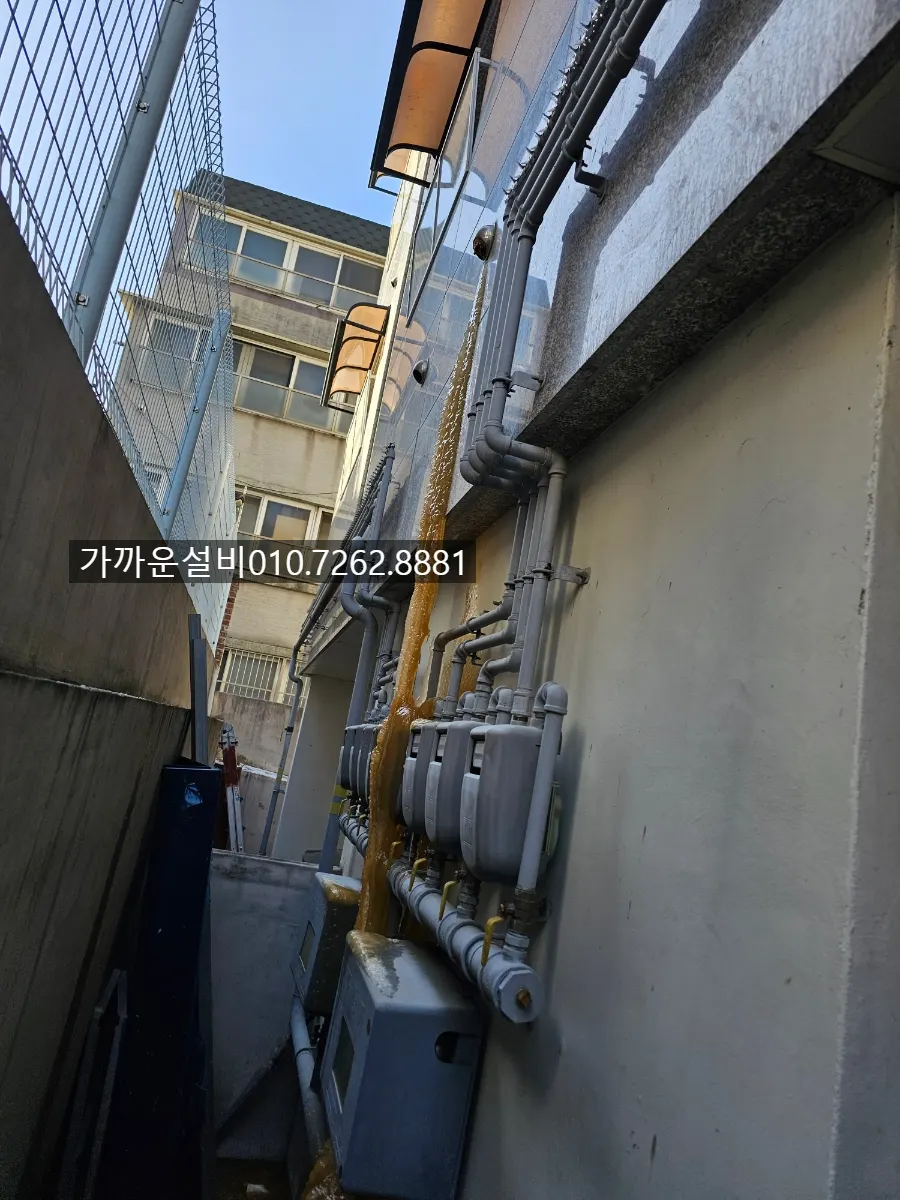
Korea announces its serious cold through 한파주의보 and 한파경보 — cold-wave advisories and warnings that flash on your phone in Korean. When you see one (or when the forecast dips below about minus 10°C for more than a night), your pipes are officially at risk. The buildings that suffer are predictable: villas and older low-rises with plumbing in exterior walls, units left empty over holidays, and anything with a water meter in an outdoor box. Modern apartment towers with interior risers mostly shrug winter off.
Know your weak points before December
- The water meter box (수도계량기함). In villas it is typically a plastic or concrete box on an outside wall, in a stairwell, or set into the ground by the entrance. It is the single most common freeze point in the country. Find yours now, not during the cold wave.
- Pipes along exterior walls — kitchen sinks on an outside wall, bathroom plumbing in unheated additions, veranda taps.
- The boiler's pipes. Wall-hung gas boilers usually hang on verandas or in external closets. The cold-water feed and the condensate drain line freeze before anything else; a frozen condensate line shuts many modern boilers down with an error code even though nothing is broken yet.
- Outdoor and rooftop taps, garden hoses left connected, and pipes in 피로티 (open ground-floor parking) ceilings.
Prevention that actually works
- Stuff the meter box. The traditional Korean method is exactly what it looks like: fill the box with old clothes, towels, or styrofoam, in a plastic bag so they stay dry, and cover the box opening. Waterworks offices hand out insulation covers in winter; your district office (주민센터) often has them too.
- On cold-wave nights, leave a thin stream of water running — a pencil-lead trickle from the tap furthest from where the water enters. Moving water resists freezing. That thin trickle of water is the cheapest insurance in this guide.
- Never switch the boiler off when leaving. Use 외출 (away) mode, or set it to a low temperature. Away mode keeps the system circulating just enough to protect itself. Turning it off to save money during a January trip is how people come home to a flooded floor — and, as a renter, possibly to the bill: an unheated unit can count as tenant negligence.
- Open the sink cabinet doors on exterior walls so room heat reaches the pipes, and disconnect garden hoses so trapped water cannot ice back into the tap.
- Wrap exposed runs with foam pipe insulation or heat cable (열선) from any hardware store. Heat cable with a thermostat is the proper fix for a tap that freezes every single year.
Already frozen? Thaw it the slow way
No water from one tap on a cold morning usually means ice somewhere between the meter and that fixture. The rules:
- Open the affected tap slightly so melting water and pressure have somewhere to go.
- Apply gentle heat, starting from the tap end and working toward the meter: towels soaked in warm (not boiling) water, a hair dryer waved along the pipe, a heating pad. Warm the meter box the same way — warm towels laid on the meter.
- Never use an open flame, and never pour boiling water on a frozen pipe or a frozen meter. The temperature shock cracks pipes and shatters meter glass — turning a frozen pipe into a burst one.
- Be patient. A properly frozen run takes an hour or more of gentle heat. If nothing has changed after a couple of hours, or the frozen section is buried where you cannot reach it, stop and get help — forcing it is what causes the damage.
A frozen meter (the dial face cracked or clouded with ice) is a case for the local waterworks office — in Seoul, dial 120 (the Dasan call center, which has English interpretation). The meter itself belongs to the waterworks; pipes on your side of it are the private side, which is where we come in. Reporting it step by step, with the Korean line to use, is in our frozen water meter guide.
Leaving Korea for weeks in winter? Winterize properly
A unit that sits empty through a cold snap needs more than crossed fingers. Before a long trip: set the boiler to 외출 mode (never off), leave interior doors and sink cabinets open so warm air circulates, and ask a neighbor or your landlord to glance at the unit after any severe cold wave. For a villa with a history of freezing, go further — shut the main valve at the meter and open all the taps for a minute to drain the lines; pipes without water in them cannot burst. Renters should tell the landlord about any long winter absence in writing: it is exactly the scenario where an unheated-unit burst becomes a negligence argument, and a message showing you took precautions changes how that argument ends.
If it bursts: the first five minutes
- Close the main valve. It is next to or inside the meter box — the same box you found in December. Turn it clockwise until the flow stops. In an apartment, the unit shut-off is usually in the meter enclosure by your front door; if you cannot find it, call the management office to shut your riser.
- Kill electricity to soaked areas at the breaker if water is anywhere near outlets or the boiler.
- Open taps to drain pressure, and move water toward the bathroom floor drain — Korea's wet-room design is your friend in a flood.
- Photograph everything, then notify — landlord, management office, downstairs neighbor if water is heading their way. Timestamped photos and messages decide the money questions later.
- Then call a plumber. Burst repairs in mid-cold-wave are a queue everywhere in the city; a clear photo of the burst point and your address gets you an honest visit window instead of a vague promise.
Winter is our busy season — here is how we handle it
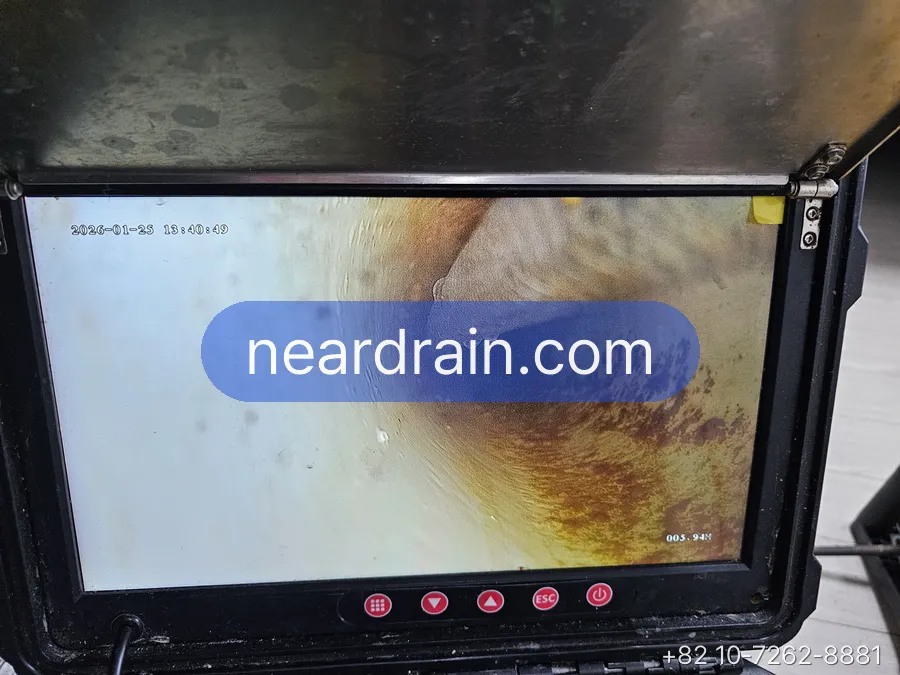
We repair burst and frozen lines across Seoul all winter, and suspected hidden damage can be checked without tearing walls open first — see leak detection and camera inspection. As always: range by text, a fixed number on site before work starts; calls and texts taken any time — a cold-wave night included, and we tell you honestly whether it is tonight or first light.
From our own job sites
No stock photos on this site — every image below was taken by our crew on a real call.