Every newcomer to Korea meets it eventually: a public restroom stall with a small waste bin beside the toilet, sometimes with a sign asking you to put used paper in the bin instead of the bowl. Reasonable people conclude that Korean plumbing cannot handle toilet paper at all, and then spend years binning paper in an apartment whose pipes would have swallowed it without complaint. As the people who get called when it goes wrong, let us sort out what is actually true.
Where the bin habit came from
The habit is historical, not technical — mostly. Buildings from Korea's rapid-growth decades were often plumbed with narrow drain lines, tight bends, and in some cases septic-style holding tanks rather than direct sewer connections. Paper that lingered in those systems caused real blockages, so a whole generation learned to keep it out of the bowl, and the bin became furniture. The habit then outlived most of the pipes that justified it.
The government has been pushing in the other direction for years. Public-restroom rules were revised in 2018 to phase the open waste bins out of stalls precisely because binned paper was the bigger hygiene problem — the official position is that toilet paper belongs in the toilet. Korean toilet paper is manufactured to disintegrate quickly in water for exactly this reason; hold a sheet in a glass of water, swirl it, and watch it fall apart within moments.
So which buildings can take it?
- Apartment complexes, officetels, and anything built or renovated in roughly the last 25 years: flush away. These have standard 100mm soil stacks and municipal sewer connections. Toilet paper is a non-event.
- Older villas and standalone houses (roughly pre-1990s): caution. Narrow or sagging cast-iron lines, improvised renovations, and long horizontal runs mean paper can snag where a newer building would carry it away. If the toilet already flushes weakly, that is your warning.
- Buildings on a septic or holding-tank system (some older low-rises and rural properties): follow the landlord's or building's instruction. Tanks fill faster with paper, and pump-outs cost money.
Not sure which you live in? Ask the management office or your landlord one question — "변기에 휴지 버려도 되나요?" (Is it okay to put toilet paper in the toilet?) — or run your own test: a modest amount of paper, one flush, and watch whether the bowl clears with the usual force several flushes in a row. A toilet that gurgles, rises high, or drains lazily is telling you about its pipes.
The one rule with no exceptions: no wipes
Whatever your building, wet wipes do not go in the toilet — ever. This includes every package labeled "flushable." Wipes are plastic-fiber fabric; they do not break down, they rope together in the pipe, and they snag on the first rough joint they meet. A remarkable share of the toilet and stack blockages we clear in Seoul come down to a wad of intact wipes, sometimes flushed months earlier. The same verdict applies to:
- Kitchen paper towels (engineered to stay strong when wet — the opposite of toilet paper)
- Dental floss, cotton pads, hair
- Cat litter, including brands sold as flushable
- Sanitary products of any kind
- Cooking oil and food scraps (they belong in Korea's food-waste system anyway)
One more Korean-specific note: bidet seats are everywhere here, and they genuinely reduce how much paper you need — but the wipes you might use alongside one still belong in the bin.
But is binning the paper actually wrong?
If your building genuinely requires it, no — follow the house rules. But understand the trade-off: an open bin of used paper is a hygiene and odor problem in a small, humid, warm room, which is precisely why public-restroom policy moved away from it. If you do bin, use a lidded bin, line it, and empty it daily in summer. If your building's pipes can take paper (most modern ones can), flushing modest amounts is the cleaner practice by every measure — the key word being modest. Half a roll in one flush will defeat a brand-new toilet in a brand-new tower; three or four sheets at a time never will.
Worth knowing when you host: many Korean guests will instinctively look for a bin, and many Western guests will instinctively flush. Neither habit is wrong — but if you live in an older villa, a small sign (or a word to your guests) protects you from the one flush that books us a visit. Buildings on holding tanks sometimes post a 정화조 (septic tank) notice near the entrance or in the contract; if you see that word anywhere in your paperwork, ask the landlord directly what the flushing rules are.
If the toilet clogs anyway
- Do not flush again. A second flush on a blocked bowl is how water ends up on the floor — and in a Korean wet-room bathroom, into the floor drain and sometimes the apartment below.
- Use a proper flange plunger (뚫어뻥 at any convenience store or Daiso) — the rubber-lipped type, not the plastic bellows. Which one, how to seat it on a Korean bowl, what the sticker (뽕투) does and the three signs to stop are all in how to unclog a Korean toilet.
- Skip the chemical drain openers. They rarely defeat a solid blockage, and they turn the bowl into a hazard for whoever works on it next.
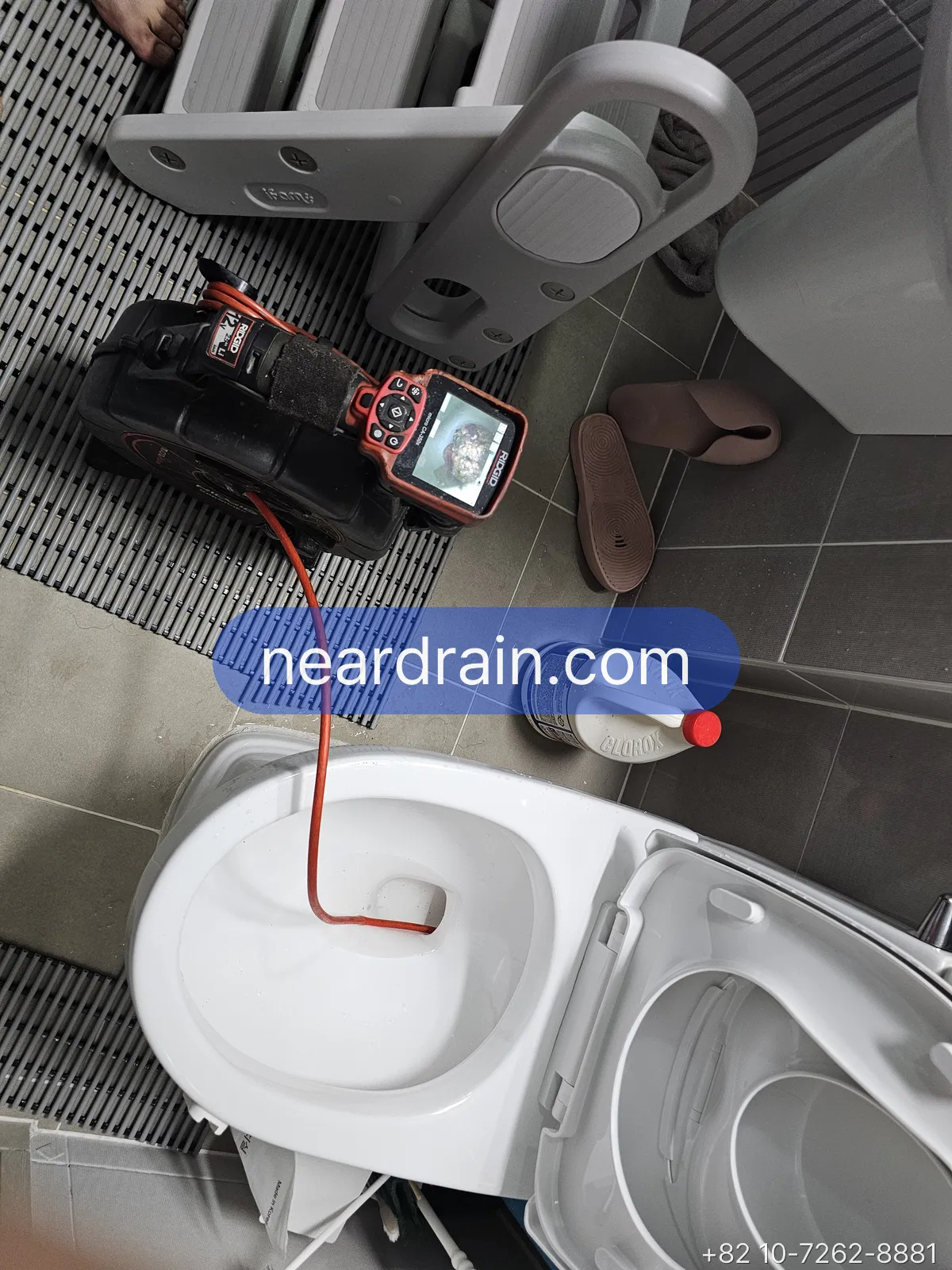
- If something fell in — phone, toy, air-pod — stop entirely. Plunging pushes objects deeper. Retrieval is usually possible when the object has not been driven down the line. Our clogged toilet service covers both cases, with the price agreed before we start.
Renters: one more wrinkle
Who pays for a toilet clog depends on what caused it — paper and wipes point at the user, old narrow pipes point at the building. We put the cause in writing after every job, which matters more than you might think: here is how the landlord-vs-tenant question actually works in Korea. And if your bathroom smells even when nothing is clogged, that is a different problem with an easier fix — see the drain smell guide.
Blocked right now?
Text us a photo of the bowl and your neighborhood. We answer with a price range and a realistic window for the visit, and confirm the fixed price on site before touching anything — you approve it first. Calls and texts taken any time.
From our own job sites
No stock photos on this site — every image below was taken by our crew on a real call.