Home › Guides › AC dripping indoors
Your air conditioner is not leaking refrigerant. Its drain is blocked.
The wall unit in your Seoul apartment drips onto the floor in August, and the first thought is "it's leaking gas." It almost never is. An air conditioner pulls litres of water out of Korean summer air every hour, and that water leaves through a thin drain hose or an in-wall drain line — the thing that is blocked (에어컨 배수관 막힘). Which type you have, the five-minute checks, what we clear from the balcony end, and where the AC company's job begins.
Which type of AC drain do you have?
- Wall unit with a hose out the window or wall (벽걸이). The condensate hose leaves the back of the unit, runs through the wall with the refrigerant lines, and ends outside — dripping onto a balcony floor, into a gutter, or onto the neighbour's awning. Villas, older apartments, most rooftop rooms.
- Apartment with an in-wall drain line (매립 배수관). Built into the wall during construction: the unit's hose plugs into a stub behind it, the line runs inside the wall or slab and ends at a stub on the balcony or joins the balcony floor drain. Anything built after the mid-2000s in Ichon, Gangnam, Banpo.
- Ceiling cassette (시스템에어컨) in offices, shops and newer high-end apartments. The tray sits above the ceiling and cannot drain by gravity, so a small lift pump with a float inside the unit pushes the water up and over to a drain line.
- Floor-standing unit (스탠드형). A long hose along the skirting to the balcony, with a low point somewhere on the way where the trouble lives.
Why it clogs in a Korean summer
Condensate is not clean water. It carries the dust off the coil, and in Seoul's July and August humidity it stays wet in the hose for weeks at a time — which is all the recipe a biofilm needs. The slime grows at whichever point the water slows: a sag in the hose, the stub where hose meets in-wall line, the elbow at the balcony end. Three things make it worse. A hose end that sits in a puddle on the balcony, so the line cannot breathe and air-locks. A hose left kinked behind the unit after the last cleaning. And the balcony floor drain the line empties into being blocked itself with lint and leaves, so the AC is draining fine into a drain that is full — the stain on the floor looks the same either way.
Check yourself in five minutes
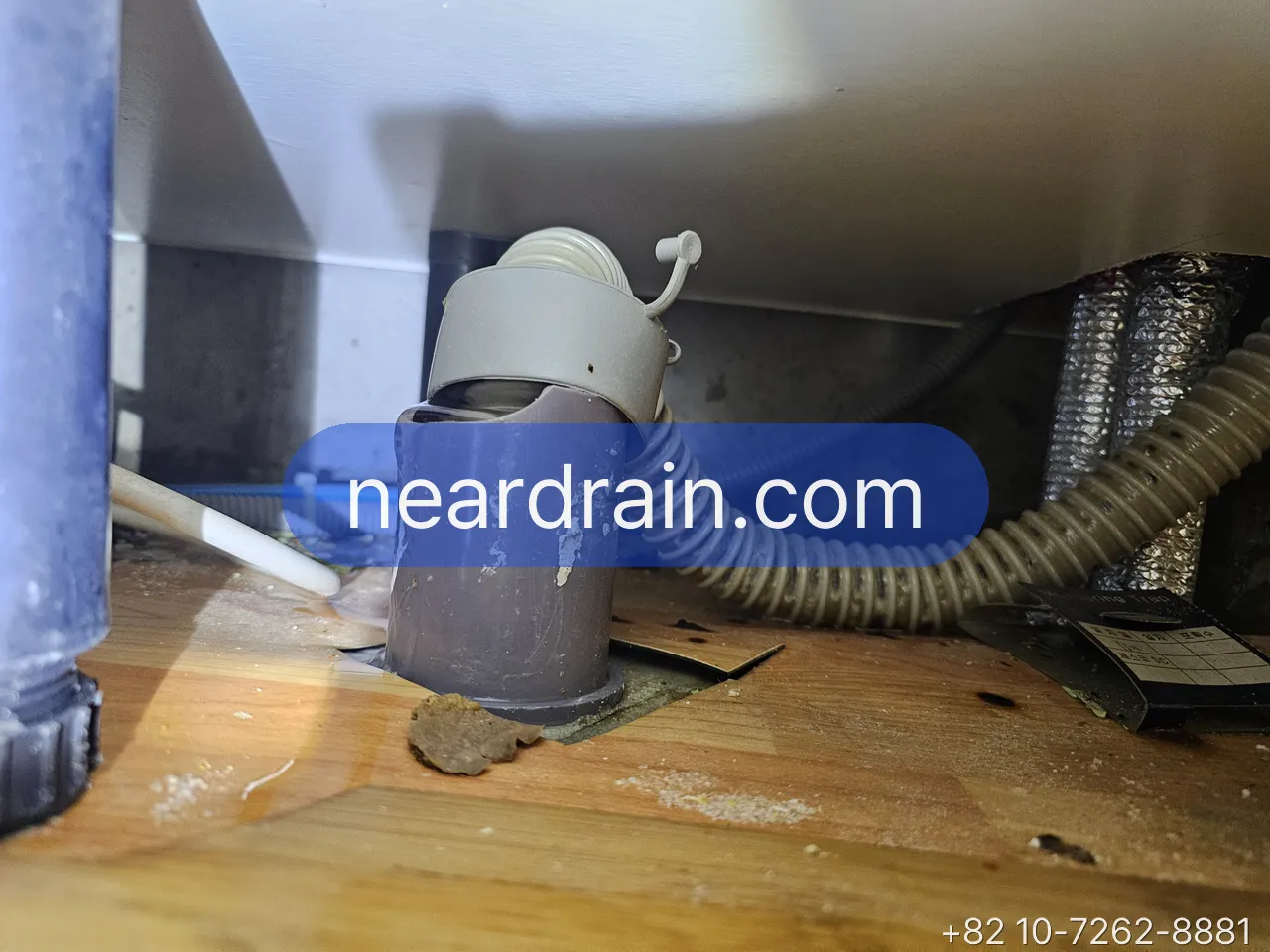
- Find the hose end outside. Balcony, exterior wall, gutter. Is water dripping from it while the AC runs? If yes, the unit is draining and the water indoors is coming from somewhere else — the tray is cracked or tilted, or the hose is split behind the unit.
- Is the end sitting in a puddle, or pushed into a full drain? Lift it clear, and empty or clear the balcony floor drain. Run the AC twenty minutes and look again.
- Look behind the unit for a kink. A phone camera on a selfie stick does it. A hose bent double at the wall entry is the whole problem in a surprising share of calls.
- Check the tray. With the AC off and the front panel lifted, the tray under the coil should be empty or nearly so. Full to the brim means the outlet from the tray is blocked at the first inch — often clearable with a bottle brush.
- The one thing not to do: blowing into the hose toward the unit. It pushes the slime plug back into the tray outlet and floods the tray over the electronics.
Hidden drain lines: how we clear them from the balcony end
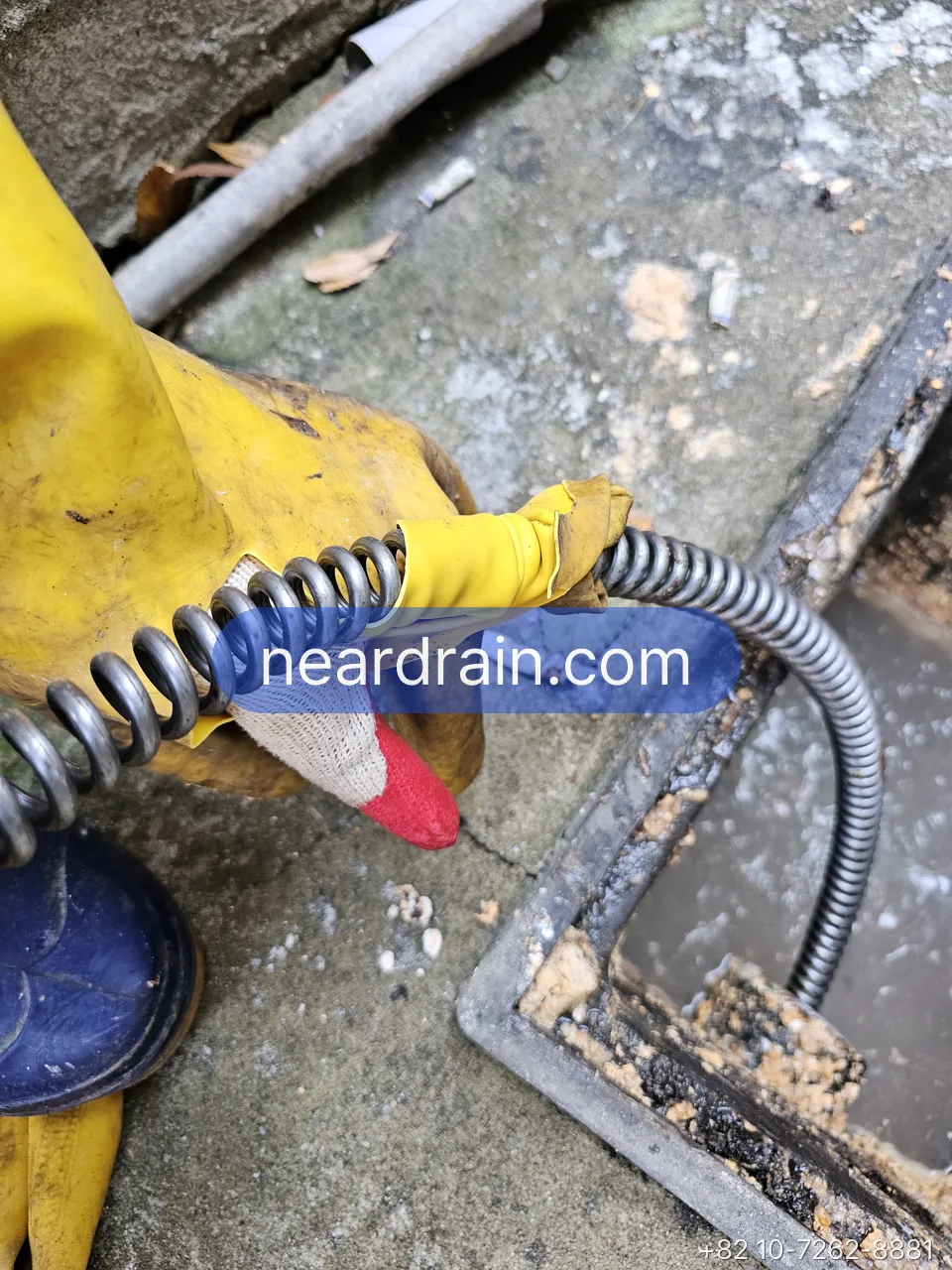
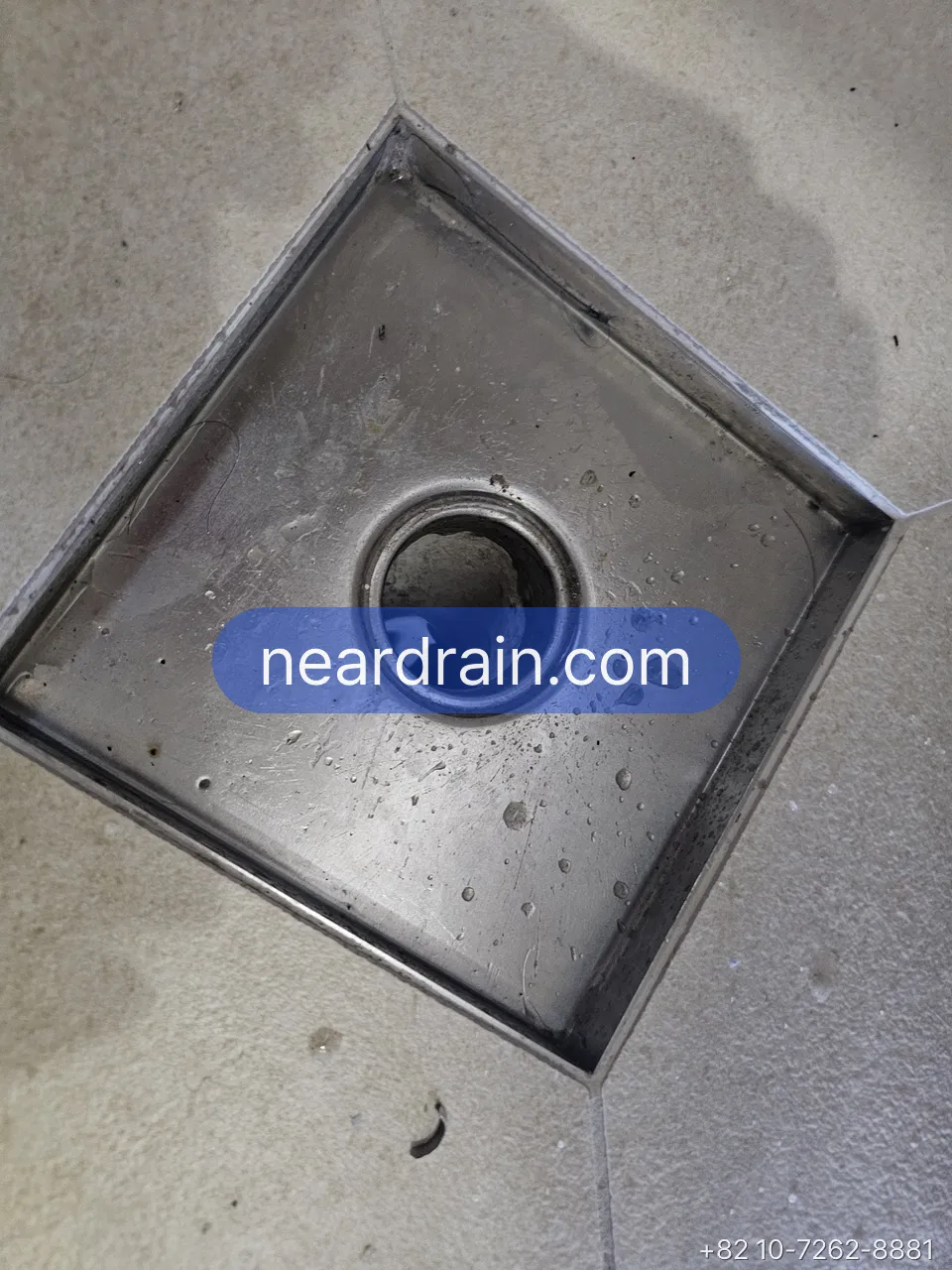
An in-wall line cannot be reached from the unit, and forcing anything down from the tray risks the tray. We work from the balcony stub: a small hand cable to break the plug, then suction from the outlet to pull the slime and the standing water out the way it was meant to go, then warm water from the tray end to confirm it runs clear. If the stub goes into the balcony floor drain rather than ending in the open, the floor drain is opened and cleared first — a lot of "AC drain" calls in Ichon and Gangnam balconies end there, with the AC never touched. And if the balcony drain is backing up from the building's shared rain riser when a neighbour above hoses their balcony, that is the riser, the management office's part, and the rooftop & balcony rain drain page explains where that line goes.
Ceiling cassettes in offices and shops: the lift pump and the float
A cassette that drips from the ceiling grille, or that shuts itself off with a code after an hour, usually has a lift pump problem: the float that tells the pump to run is stuck in slime, the pump inlet screen is blocked, or the pump has failed. The panel comes down, the tray and float are cleaned, the pump is tested with water poured into the tray — and if it does not run, it is replaced as a part. A cassette whose pump runs and still drips has a blocked line after the pump, cleared like any other. This is the one AC job where we and the AC service line overlap, and the split is simple: pump, float and drain line are the water path and ours; anything electronic that stops the pump being told to run is theirs.
Not us: refrigerant, compressor, error codes, coil cleaning
Low cooling, ice on the pipes, a hissing outdoor unit, an error on the display, a smell from the fan, a filter that needs a wash — those are the AC company (제조사 AS) or an AC cleaning company, and we would only be guessing inside the unit. What we handle is the water after it leaves the tray. If you send a photo and it is not a drain problem, we say so and you keep the call-out for the right trade.
Renters: the landlord's AC vs your own, and the photo that settles it
An AC that came with the flat is the landlord's appliance, and a blocked in-wall drain line is the building's fabric — both normally the landlord's to fix. An AC you bought and had installed is yours, hose and all, though the in-wall line it plugs into is still the building's. The photo that settles which is which: the unit's rating sticker (model and install year), and the stub on the balcony where the hose ends. Send both to the landlord with a line in Korean — "에어컨 배수관이 막혀서 실내로 물이 떨어집니다. 사진 첨부합니다. 확인 부탁드립니다." — and then to us. The who-pays guide covers the reasoning.
Questions people ask with a towel under the AC
The unit drips only when it has been running an hour. Is that the drain?
Almost certainly. An AC makes condensate at a steady rate; a drain that is partly blocked keeps up for the first half hour and then the tray overfills and spills. A drain that is fully blocked drips within minutes. A unit that drips the moment it starts, before any condensate could have formed, is ice melting off the coil from an earlier run — still a drain or airflow problem more often than a gas one, but that one is worth mentioning to the AC service line if it repeats.
Can I pour something down the drain hose?
Warm water from the tray end, yes, and it is a fair first test. Chemical drain opener, no — it sits in the tray under the coil, corrodes the aluminium fins, and comes back at you as fumes when the fan runs. Bleach diluted heavily is what AC cleaners use on the tray itself; pouring it into a hose whose far end is somewhere in a wall is guesswork. If warm water from the tray end does not drain freely, stop and clear from the outlet end instead.
Water comes out of the wall below the AC in a new apartment. Who do I call?
In a newer apartment the AC drain is an in-wall line (매립 배수관) that runs from the unit to a stub on the balcony or into the balcony floor drain. Water appearing on the wall below the unit means the line is blocked and the condensate is backing up inside the wall — that is a drain line, which is us, and it is cleared from the balcony end. If the wall is wet in winter with the AC off, it is not the AC at all; start at the water leak detection page.
Does this apply to a floor-standing unit?
Yes. A floor-standing (스탠드형) unit has a bigger tray and a longer hose, usually run behind the unit along the skirting to the balcony. The hose sags, holds a puddle, grows slime in the puddle, and blocks at the low point. Lift the hose so it runs downhill all the way, and if it still will not drain, it needs clearing from the outlet end like any other.
Do you clean air conditioners?
No. Coil cleaning, filter and fan cleaning, refrigerant, compressors, error codes and anything inside the unit are the AC service line (제조사 AS) or an AC cleaning company. What we clear is the water path after the tray: the hose, the in-wall drain line, the balcony drain it empties into, and the lift pump on a ceiling cassette when it is a pump-and-float problem rather than an electrical one.
Send the unit, the hose end and the balcony drain
Three photos and we can tell a kinked hose from a blocked in-wall line from a full balcony drain — and whether it is us or the AC company. Cleared from the balcony end, quoted on site before work. Calls and texts taken any time.
Small drains, from our own sites
No stock photos on this site — every image below was taken by our crew on a real call.